
Long before calendars, cities, currencies, or organized systems of counting existed, human beings already needed to distinguish one object from many, one animal from the rest of the herd, one person among countless others. From this seemingly simple necessity emerged one of the most fundamental ideas in human history: the concept of unity.
The number 1 is far more than the first element in a sequence. It marks the moment when something ceases to be part of an indistinct whole and becomes recognized as a distinct existence. Perhaps that is why, over the centuries, so many cultures came to see it as more than a quantity, transforming it into a symbol of origin, identity, and new beginnings.
The First Number in History
The idea of “one” almost certainly predates writing itself. Prehistoric peoples were already capable of distinguishing a single animal from a group, one tool from many, or one day from a succession of days. Long before numerical symbols were invented, humanity had already developed the ability to perceive unity as a distinct reality.
When the earliest civilizations created numerical systems, the number 1 naturally became the starting point of counting, establishing the foundation upon which every other number would be organized.
Although this development belongs to the history of mathematics, its influence extended far beyond calculation. The recognition of unity also shaped ideas about identity, individuality, and the organization of knowledge itself, allowing the first number to acquire a symbolic significance that continues to resonate today.
Unity as a Foundation
Within mathematics, the number 1 occupies a unique position. It is known as the multiplicative identity, because multiplying any number by one leaves its value unchanged. This property belongs solely to mathematics and carries no symbolic meaning in itself.
Nevertheless, philosophers and scholars throughout history have seen in this characteristic an intriguing metaphor: the ability to preserve one’s essential nature while entering into relationships with the surrounding world.
This comparison does not transform a mathematical property into a philosophical truth. Rather, it illustrates how scientific concepts often inspire cultural interpretation. The symbolism of the number 1 emerged precisely from this dialogue between the objective world of mathematics and humanity’s enduring tendency to assign meaning to numbers.
The Symbol of Identity
Few questions have accompanied the human experience as persistently as “Who am I?”
At different stages of life, people seek to understand their own identity, recognize the choices that define them, and discover a path that is uniquely their own. This search for individuality may help explain why the number 1 has often been associated, in various symbolic traditions, with autonomy, selfhood, and personal affirmation.
There is no universal interpretation linking the number 1 to identity. Yet many philosophical, cultural, and symbolic traditions have viewed unity as a powerful image of something that exists in and of itself.
From this perspective, the first number ceases to be merely a quantity and becomes a symbol of the emergence of something new—something capable of occupying its own place in the world.
The Number 1 in Numerology
Among the many traditions that assign symbolic meanings to numbers, numerology commonly associates 1 with beginnings, initiative, and the ability to open new paths.
Many schools interpret it as representing the impulse to act, create, or take the first step toward a new experience. Others emphasize qualities such as independence, self-confidence, and leadership.
As with numerology as a whole, these interpretations belong to symbolic traditions. They should not be understood as objective descriptions of personality, nor are they supported by scientific evidence. Nevertheless, they illustrate how the number 1 has become, for many people, a symbolic language through which qualities associated with beginnings and individual initiative can be expressed.
The Shape of the Number
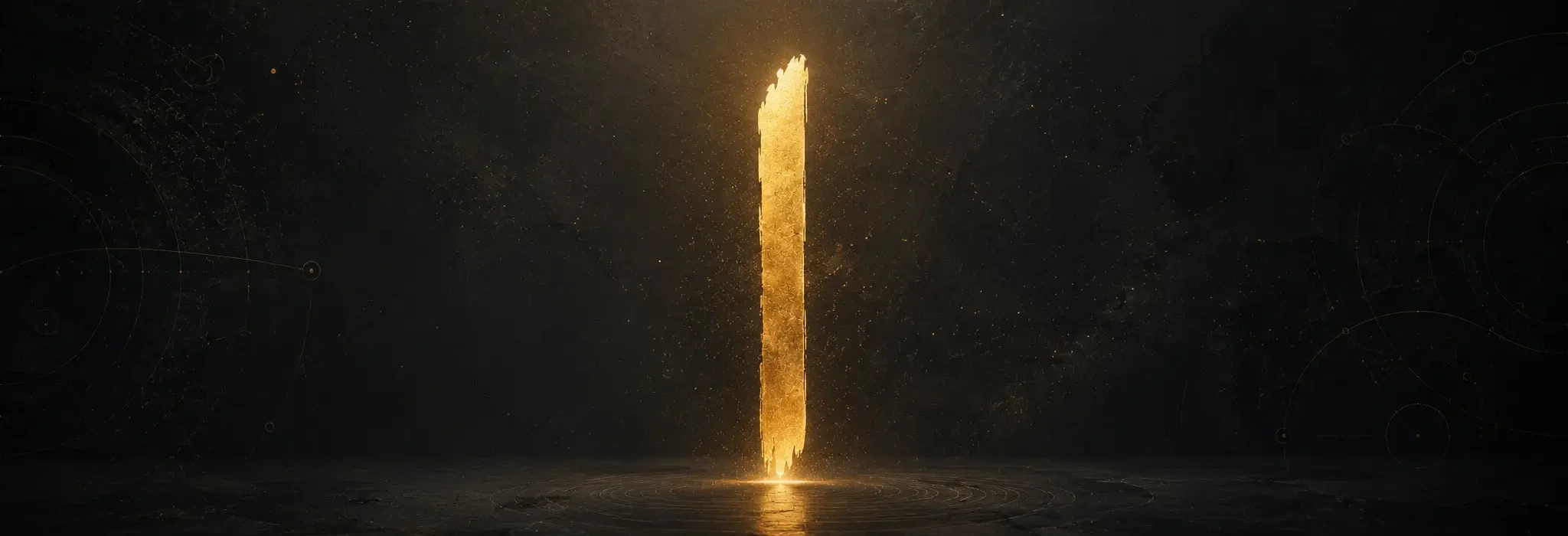
Unlike numerals whose forms may suggest cycles, balance, or continuity, the numeral 1 is typically represented as a single vertical stroke.
Although this appearance is the result of the historical evolution of numerical writing rather than intentional symbolic design, many interpretations have associated its simplicity with ideas such as direction, stability, and unity.
As with countless other cultural symbols, these associations do not belong to the number itself, but to the meanings that societies have attached to its form over time.
For some, a solitary vertical line suggests firmness and stability. For others, it evokes beginnings, purpose, or simply the graphic expression of unity. This diversity of interpretations reminds us that symbolism rarely resides within an object itself; rather, it emerges through the relationship between symbols, culture, and human experience.
When One Becomes Many
Nearly every great human achievement shares one essential characteristic: it begins with a single action.
A forest begins with a seed.
A library begins with its first book.
A journey begins with a single step.
A scientific discovery begins with a question that has not yet been answered.
Before there can be growth, expansion, or multiplication, there is always an initial moment.
Perhaps that is why so many traditions associate the number 1 with the idea of origin. Its symbolism lies not necessarily in the success of what follows, but in the moment when something ceases to exist merely as a possibility and becomes part of reality.
What Can the Number 1 Symbolize?
The symbolism of the number 1 does not rest on the claim that it determines behavior or destiny. Rather, it reflects the wide variety of interpretations that different cultures have developed throughout history.
In some contexts, it represents unity; in others, origin, identity, independence, or the capacity to initiate new paths. These interpretations are neither universal nor objective. Instead, they illustrate humanity’s enduring tendency to transform mathematical concepts into metaphors for understanding life itself.
From this perspective, the number 1 may serve as a symbol for those moments when a decision breaks inertia and marks the beginning of a new chapter. More than representing any particular person or personality trait, it reminds us that every transformation begins when an intention takes its first concrete form.
A Reflection
The number 1 is the smallest positive natural number, yet it may also be one of humanity’s greatest symbols.
Without it, there would be no concept of unity. Without unity, it would be difficult to organize counting, distinguish identities, or construct the numerical systems that describe the world around us.
Perhaps that is precisely the source of its enduring fascination.
Within a single symbol, the number 1 brings together ideas of origin, presence, individuality, and new beginnings. None of these meanings belongs inherently to the number itself. Rather, they emerged through the ways different cultures interpreted it across history.
It is this remarkable capacity to transform a simple unit into a universal symbol of beginnings that has made the number 1 one of the most enduring and meaningful symbols ever created by humanity.