
Reading time: 25 minutes
Long Before Mathematics, There Was the Need to Understand the World
It is difficult to imagine a world without numbers. They appear on the clocks that measure our hours, the calendars that organize our days, the currencies that drive economies, the speedometers in our vehicles, the temperatures we monitor, the distances between cities, and even the binary code that powers modern computers. Nearly everything we do depends on counting, measuring, or calculating in some form.
Yet numbers did not always exist.
There was a time when humanity had no symbols to represent quantity and no words specifically designed to express it. Long before calendars, equations, or mathematical systems emerged, people were already faced with practical questions: How many animals belonged to the herd? How many days had passed since the river last flooded? How many seeds remained for the next planting season? How many people were part of the community?
These questions arose long before writing, long before cities, and even before the development of organized agriculture. At some point in prehistory, our ancestors realized that memory alone was no longer enough. They needed a way to record quantities, compare information, and preserve knowledge beyond the present moment.
From this practical necessity emerged one of humanity’s greatest intellectual achievements.
Numbers were not discovered in nature like hidden treasures waiting to be found. They were gradually created over thousands of years by different peoples, in different places, and at different moments in history. Every civilization contributed another piece to an immense intellectual puzzle that continues to evolve today.
This remarkable story rarely receives the attention it deserves. When we think of numbers, we often associate them immediately with classroom mathematics, arithmetic exercises, or scientific formulas. Yet their history extends far beyond mathematics alone. It intersects with archaeology, history, anthropology, philosophy, linguistics, astronomy, economics, religion, psychology, and many other fields of knowledge.
While numbers enabled humanity to measure land, construct monuments, predict eclipses, and eventually develop technologies capable of exploring space, they also inspired symbols, beliefs, and cultural interpretations. Across many of the world’s great civilizations, certain numbers came to represent ideas, values, and principles that reached far beyond their mathematical function.
This coexistence of the objective and the symbolic has accompanied numbers for thousands of years. They describe reality, yet they also help cultures organize narratives about the world. They are scientific tools while simultaneously serving as powerful elements within philosophical, religious, and spiritual traditions. They measure time, but they also inspire reflection on existence itself.
Understanding this dual nature is essential to understanding numbers themselves.
For that reason, this guide is not intended merely to explain how numbers work. Its purpose is to present a broader perspective on the extraordinary journey that transformed simple marks carved into bones and stones into a universal language capable of connecting civilizations, advancing scientific knowledge, and revealing patterns woven throughout nature.
Throughout this guide, we will explore how the earliest systems of counting emerged, how different societies developed their own ways of representing quantity, how mathematics evolved across history, and why numbers eventually came to occupy an important place not only in science but also in culture, philosophy, and symbolic traditions.
The Beginning of NATORUM’s Library of Numbers
This guide also serves as the starting point for NATORUM’s Library of Numbers.
Rather than treating numbers solely as mathematical objects or exclusively as symbols rich in meaning, this collection approaches them from a broader, interdisciplinary perspective. Each article explores a different dimension of the numerical world, carefully distinguishing what belongs to history, science, culture, and interpretive traditions.
This distinction matters because different forms of knowledge answer different kinds of questions.
Mathematics investigates quantitative properties and relationships.
History examines how numerical ideas emerged and evolved over time.
Anthropology explores how different societies incorporated numbers into everyday life.
Traditions such as numerology, meanwhile, offer symbolic interpretations that belong to particular cultural, philosophical, or spiritual systems rather than to scientific consensus.
Throughout this library, these perspectives are presented side by side, with their contexts, purposes, and limitations clearly identified.
To study the history of numbers is to understand far more than the evolution of mathematics. It is to follow one of humanity’s most remarkable intellectual journeys—a story that began long before books, schools, or computers, when someone, somewhere in the distant past, realized that the world first had to be counted before it could truly be understood.
Long Before Mathematics, There Was the Need to Count
If a child today learns to count using an orderly sequence of symbols—1, 2, 3, 4, 5—it is easy to assume that numbers have always existed in this form. History tells a very different story.
The earliest human beings did not need to solve equations or calculate planetary motions. Their concerns were far more immediate: surviving, feeding their communities, protecting their families, and adapting to an ever-changing environment. Yet even in a world without writing, cities, or formal mathematics, one ability quickly became indispensable: recognizing quantity.
This capacity almost certainly predates modern humans themselves. Many animals can distinguish between small quantities, recognize the difference between larger and smaller groups, and respond accordingly. Primates, birds, fish, and many other mammals display elementary forms of numerical perception that help them find food, avoid predators, and care for their young.
Human beings inherited this natural ability—but they took it much further.
Rather than simply recognizing the difference between “more” and “less,” they began recording those differences, comparing them, and sharing them with others.
This was the birth of counting.
Counting did not emerge as the invention of a single civilization or a single individual. Instead, evidence suggests that many communities independently developed similar ways of recording quantities according to their own needs.
A hunter needed to remember how many animals had been caught. A shepherd needed to verify that the entire flock had returned at sunset. A farmer needed to keep track of the seeds stored for the next planting season. Although these situations differed, they all posed the same challenge: how to keep a reliable record of quantities over time.
Each required something that memory alone could not always provide—a dependable way to preserve numerical information.
That is how the earliest counting marks appeared.
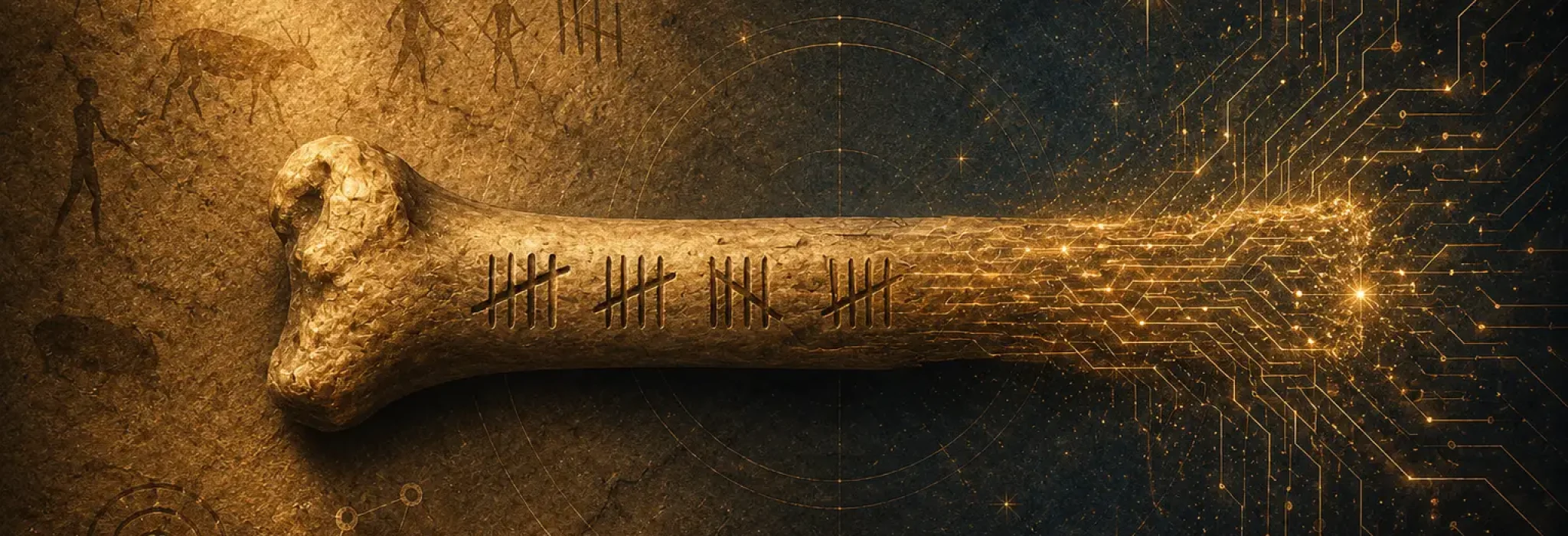
These records were remarkably simple. A single notch represented one animal. Two notches represented two animals. Small stones could stand for stored goods. Knots tied in cords served as reminders of specific quantities. In some cases, wooden sticks or animal bones were carved with successive marks to record important events.
There were no numerals.
There were no names for large numbers.
There was only humanity’s first attempt to transform experience into a lasting record.
Remarkably, this first step already reveals a characteristic that would remain true throughout the entire history of numbers: they were never merely tools for calculation. From the very beginning, they served as instruments for preserving information, organizing collective life, and building memory.
Long before mathematics was born, something even more fundamental had already emerged—the idea that reality itself could be represented through symbols.
That idea would change the course of human history forever.
When Counting Was No Longer Enough
For a long time, a series of marks carved into a bone or a collection of stones arranged in small piles was sufficient to meet the needs of daily life. As long as human communities remained relatively small and depended primarily on hunting and gathering, recording a few dozen animals, tools, or food supplies was enough to keep society organized.
But human history never stood still.
As populations grew and ways of life became increasingly complex, so did the amount of information that needed to be recorded. Permanent settlements gave rise to organized agriculture. Agriculture produced surpluses. Surpluses encouraged trade. Trade connected distant peoples. And with expanding commerce came new demands for accounting, comparison, and planning.
The old method of making one mark for each animal was no longer enough.
How could hundreds of sacks of grain be recorded? How could taxes collected from dozens of families be tracked? How could merchants keep account of goods carried by caravans traveling across vast distances? How could the time required for planting, harvesting, or constructing a temple be calculated?
Within this new reality, simple counting began to evolve into something far more sophisticated.
Symbols gradually ceased to represent only physical objects and began to express abstract ideas. The same sign could represent a quantity regardless of what was being counted. Today this change may seem obvious, but it represents one of the greatest intellectual breakthroughs in human history.
In other words, numbers began to free themselves from the objects they described.
Previously, five marks meant five animals, five stones, or five pieces of fruit. Gradually, the concept of five came to exist independently—as an idea separate from the things being counted. This remarkable capacity for abstraction laid the foundation for every mathematical development that followed.
At the same time, different civilizations created their own ways of organizing numerical representation. Some developed base-five systems, likely inspired by the fingers of one hand. Others adopted base ten, reflecting the ten fingers on both hands. Still others employed entirely different systems, including the base-sixty mathematics of ancient Mesopotamia and the base-twenty systems found in parts of Mesoamerica.
These choices did not arise because one civilization was more advanced than another. Rather, they reflected practical needs, local traditions, and different ways of understanding and organizing the world.
This diversity reveals one of the most fascinating aspects of the history of numbers: although human societies faced many of the same challenges, there was never a single solution. Every culture developed its own methods for representing quantities, preserving information, and constructing systems of counting.
It was precisely this rich diversity of approaches that laid the foundation for the emergence of the world’s first organized numeral systems.
The First Number Systems Changed History
When we think about the history of numbers, it is tempting to imagine a straight line of progress, as though one civilization simply passed its knowledge on to the next. The reality was far richer.
Many societies developed their own number systems, often independently, adapting them to the needs of their time and environment. Some were relatively simple. Others displayed a remarkable level of sophistication. Despite their differences, they all reveal the same essential truth: representing quantities had become a permanent necessity for human societies.
In ancient Mesopotamia, for example, the Sumerians and later the Babylonians created one of the most influential number systems in history. Instead of the base-ten system we use today, they relied primarily on a base-sixty system. At first glance, this choice may seem unusual, but it offers important mathematical advantages because sixty has many whole-number divisors. Remarkably, this legacy is still with us whenever we divide an hour into sixty minutes or a circle into three hundred and sixty degrees.
In Ancient Egypt, counting was closely connected to the administration of the state. Officials needed to measure land after the annual flooding of the Nile, manage food supplies, organize large construction projects, and record taxes. The Egyptians developed distinct symbols for different orders of magnitude, allowing them to represent large numbers without endlessly repeating the same marks.
In ancient China, mathematics evolved alongside astronomy, commerce, and imperial administration. Counting rods made it possible to perform sophisticated calculations centuries before the invention of mechanical calculators, while mathematical treatises reveal an impressive understanding of algebra, geometry, and practical problem-solving.
In Mesoamerica, the Maya developed one of the most original number systems of the ancient world. Based primarily on a vigesimal (base-twenty) system, it combined dots, bars, and a dedicated symbol for zero—an extraordinarily advanced solution for its time. This system enabled highly accurate astronomical calculations and the creation of remarkably sophisticated calendars.
Meanwhile, in India, a breakthrough emerged that would eventually shape nearly all of modern mathematics. There, the positional decimal system was refined, allowing the value of a digit to depend on its place within a number. Combined with the mathematical development of the concept of zero, this innovation made calculations far more efficient and laid the foundation for the numeral system now used across most of the world.
Each of these civilizations solved a similar challenge in its own way. There was never a single moment when numbers were “invented.” Instead, they emerged through a long process of collective human ingenuity that unfolded over thousands of years, often among societies that had little or no contact with one another.
This perspective profoundly changes the way we understand history.
Numbers do not belong to any single civilization. They are part of humanity’s shared intellectual heritage.
Although these systems differed greatly, each contributed to the gradual evolution of mathematical thought. Along this journey, a series of discoveries fundamentally transformed the way human beings represented and understood quantities.
Over thousands of years, new ideas steadily changed how people recorded, interpreted, and used numbers. The timeline below highlights some of the most important milestones in this remarkable journey.
Timeline of the Evolution of Numbers
- c. 20,000 BCE — Earliest known counting records appear on prehistoric artifacts.
- Prehistory — The first methods of counting emerge to support hunting, gathering, and the organization of daily life.
- c. 3400 BCE — The first organized number systems develop in Mesopotamia.
- c. 3000 BCE — Numeration systems emerge in Ancient Egypt.
- c. 1200 BCE — Major advances in mathematics and calculation methods take place in ancient China.
- 3rd–7th centuries CE — The concept of zero and the positional decimal system become firmly established in India.
- Middle Ages (12th–13th centuries) — Indo-Arabic numerals spread throughout Europe, gradually replacing earlier numeral systems.
- Today — Numbers underpin modern science, technology, computing, and artificial intelligence.
Each of these milestones is explored in greater depth throughout the Natorum Library of Numbers, providing not only historical context but also a deeper understanding of why these developments transformed human civilization.
Among them, none has had a greater impact than the development of the concept of zero. Far more than a symbol representing the absence of quantity, zero made possible an entirely new way of writing numbers, performing calculations, and building mathematical systems that continue to shape science and technology today.
The story of this extraordinary invention is both rich and complex, involving multiple civilizations, centuries of intellectual progress, and a series of breakthroughs that permanently changed the course of mathematics.
When Numbers Began to Explain the World
Once different civilizations developed increasingly sophisticated ways to represent quantities, numbers began to fulfill a role that no one could have imagined in their earliest days.
They ceased to be merely tools for counting and gradually became instruments for explaining the world. This transformation was quiet, yet it profoundly changed the course of human history. Numbers were no longer simply records of quantity—they became a language capable of revealing patterns and helping humanity understand nature itself.
For thousands of years, counting answered practical questions: How many animals were in the herd? How many days remained until the harvest? How many goods would arrive at the marketplace? At some point, however, scholars realized that numbers could do far more than record reality.
They could reveal relationships that were otherwise invisible.
Gradually, it became clear that nature was not merely a collection of isolated events, but a network of recurring patterns. The length of a string affected the sound it produced. The phases of the Moon returned at predictable intervals. The seasons followed repeating cycles. Shadows shifted throughout the day according to consistent principles. Even the movements of the planets, though remarkably complex, followed recognizable patterns.
Little by little, different civilizations came to understand that many natural phenomena obeyed underlying regularities. Numbers ceased to be merely administrative tools and became a means of exploring how the universe itself operates. This shift represents one of the greatest intellectual revolutions in human history, marking the moment when humanity began to suspect that nature possessed an underlying order—one that could be observed, investigated, and described.
The question was no longer simply “How many?” It also became “How?” and “Why?”
That change laid the foundation for the birth of science and introduced an entirely new way of investigating reality.
The Invisible Language of Science
Today, it is common to hear that mathematics is the language of science. The statement may sound simple, yet its implications are extraordinary.
No other language created by humanity can describe the motion of planets, the behavior of light, the growth of a population, the spread of a disease, or the structure of an atom with such precision.
When a physicist writes an equation, they are doing far more than performing a calculation. They are describing a relationship observed in nature. When an engineer designs a bridge, mathematical models are used to predict how different materials will respond to weight, wind, and the passage of time. When a meteorologist forecasts the path of a hurricane, millions of numerical data points are combined to produce increasingly accurate predictions.
Numbers became the bridge between observation and understanding, allowing humanity not only to record natural phenomena but also to explain them. This new ability fueled some of the greatest advances in the history of knowledge. Astronomy evolved beyond simple observation to predict eclipses and planetary motion. Medicine adopted increasingly precise measurements to better understand the human body. Physics developed laws capable of explaining phenomena ranging from the fall of an apple to the motion of galaxies. Engineering relied on mathematical calculations to design bridges, buildings, and dams that transformed civilizations.
More recently, computing has taken this evolution to an entirely new level by converting numbers into digital information. Photographs, music, videos, texts, and nearly every technology we use each day exist because billions of numerical combinations are continuously processed by computers. It is remarkable that, despite their constant presence, we rarely think of numbers in this way. They have become so deeply integrated into everyday life that they have almost disappeared from our awareness, forming the invisible infrastructure upon which much of the modern world depends.
When we look at a digital photograph, we seldom imagine that it is composed of millions of tiny numerical values. When we listen to music through a streaming service, we rarely consider that every sound has been translated into mathematical data. And when we use a navigation app, we seldom realize that its accuracy depends on calculations performed by satellites orbiting the Earth. Numbers have become so ubiquitous that they have virtually vanished from view, quietly supporting much of modern life as an invisible foundation.
When Culture Also Began to Speak Through Numbers
If science found in numbers a language for describing nature, cultures around the world discovered another possibility: using them to tell stories. In virtually every known society, certain numbers came to occupy a special place in the collective imagination, appearing repeatedly in myths, religious rituals, calendars, architecture, folk traditions, and philosophical narratives.
This phenomenon did not emerge in a single place or at a single moment in history. On the contrary, it appears across continents, in cultures that often had no contact with one another, and throughout historical periods separated by thousands of years. This recurrence does not suggest that particular numbers possess universal meanings. Rather, it reflects a deeply human tendency to use numerical patterns to organize experience, preserve knowledge, and make sense of the world.
The number three, for example, is frequently associated with ideas of balance, completeness, or transformation in many traditions, although these meanings vary according to cultural context. The number seven appears repeatedly in religious narratives, cycles of time, and symbolic systems. Twelve is often linked to the organization of time, the months of the year, divisions of the heavens, and numerous social structures. Four, in turn, is commonly associated with the cardinal directions, the seasons, or the natural elements in certain cultures.
These examples do not imply that each number has a universal symbolic meaning. On the contrary, they demonstrate that different societies have assigned different interpretations to the same numbers according to their historical, religious, philosophical, and social contexts. Just as a single word may carry different meanings depending on the language in which it is used, numbers can also acquire distinct symbolic interpretations depending on the cultural tradition in which they appear.
This distinction is essential. When we study the symbolism of numbers, we are examining cultural expressions rather than mathematical properties. Understanding these traditions means understanding the ways different societies have organized their beliefs, values, and narratives throughout history. It is precisely this diversity of interpretation that makes the subject so fascinating, for numbers reveal not only how humanity learned to count, but also how it learned to think.
Why Do Human Beings Assign Meaning to Numbers?
This is perhaps one of the most intriguing questions explored throughout this library: why did symbols originally created to represent quantities come to acquire such profound meanings across different cultures? The answer lies not in a single cause, but in the convergence of psychological, cultural, and historical factors that have shaped the human way of observing and interpreting the world.
Part of the answer lies in the way the human mind works. We are exceptionally skilled at recognizing patterns—a capacity that played a vital role in our survival for thousands of years. Identifying seasonal cycles, recognizing animal tracks, noticing changes in vegetation, or anticipating dangerous situations significantly increased the chances of survival. Over time, this same ability extended far beyond practical necessity and began to influence the way we interpret reality itself.
The human mind naturally seeks regularities, even when they are not immediately apparent. We tend to organize information, create categories, establish relationships, and search for meaning in seemingly unrelated events. Numbers provide particularly fertile ground for this process because they combine order, repetition, and simplicity, making them natural reference points for building patterns and systems of interpretation.
Alongside this psychological tendency, cultural developments also played an essential role. Throughout history, societies have used numbers to structure calendars, divide time, organize ceremonies, construct narratives, and transmit knowledge. As generations passed, many of these practical functions gradually acquired symbolic significance, reflecting the beliefs, values, and worldviews of the cultures that embraced them.
Philosophy also contributed to this process. Some schools of ancient thought regarded numbers as a way of understanding the harmony underlying nature, while others used them to reflect on proportion, balance, and order. Across different historical periods, religion, philosophy, art, and popular tradition each incorporated numbers into their own symbolic languages, assigning meanings that reflected their particular ways of understanding the world.
This does not mean, however, that all of these symbolic systems describe objective facts about reality. Rather, they belong to the ways human societies create culture, organize experience, and develop frameworks for interpreting the world. This distinction is fundamental throughout the NATORUM Library of Numbers. Whenever symbolic interpretations are presented, they are identified as cultural traditions or specific schools of thought—not as universal truths or scientific evidence.
This approach allows us to appreciate the richness of these traditions without confusing their different purposes. After all, understanding a symbol does not require believing that it literally explains how the universe works. It simply requires understanding the historical and cultural context in which it emerged, and the role it played for the people who gave it meaning.
Numbers Continue to Shape Human History
Few inventions have accompanied humanity as closely as numbers.
Long before schools, books, or computers existed, our ancestors carved simple marks into bones, stones, and pieces of wood to record hunted animals, passing days, harvested crops, or accumulated possessions. Those modest marks marked the beginning of one of the greatest intellectual transformations in human history.
Over the centuries, numbers have accompanied nearly every major achievement of civilization. They were present when the first farmers learned to recognize the return of the seasons. They enabled merchants to keep records of goods long before the invention of paper. They helped architects calculate the proportions that made it possible to build monuments that have endured for millennia.
They also guided navigators across the oceans, gave astronomers the tools to predict eclipses, provided scientists with a language for describing the laws of nature, and, much later, made possible the development of computers, the internet, satellites, and artificial intelligence.
Throughout this extraordinary journey, numbers have done far more than solve practical problems. They have inspired stories, philosophies, calendars, symbols, religious traditions, works of art, and countless ways of interpreting reality that continue to inspire curiosity today.
This remarkable diversity reveals a simple truth: numbers have never been merely tools for calculation. Throughout history, they have become one of humanity’s most powerful languages for understanding the world. In some contexts, that language takes the precise and rigorous form of mathematics; in others, it appears as a cultural, philosophical, or symbolic expression. None of these perspectives invalidates the others. Each seeks, in its own way, to answer the questions that different societies have asked about reality.
Perhaps it is precisely this ability to move between the concrete and the abstract that makes numbers so fascinating. They measure the distance between stars, describe the behavior of matter, organize calendars, and support technologies that have profoundly transformed human life. At the same time, they inspire reflections on time, order, balance, beauty, and meaning, demonstrating that the same language can serve both scientific inquiry and cultural expression.
Few ideas have accompanied humanity for so long while remaining both so familiar and so mysterious. Our ancestors could hardly have imagined that the first marks carved into stone would one day lead to computers, satellites, and artificial intelligence. Yet every advance has grown from the same deeply human desire to understand the world—a search that continues today, and one in which we all still take part.
Learning to count has never meant merely learning about quantities. It has meant discovering a new way of observing the universe—and, at the same time, a new way of understanding ourselves.
Recommended Reading
- Georges Ifrah — The Universal History of Numbers: From Prehistory to the Invention of the Computer
- Charles Seife — Zero: The Biography of a Dangerous Idea
- Carl B. Boyer — A History of Mathematics