
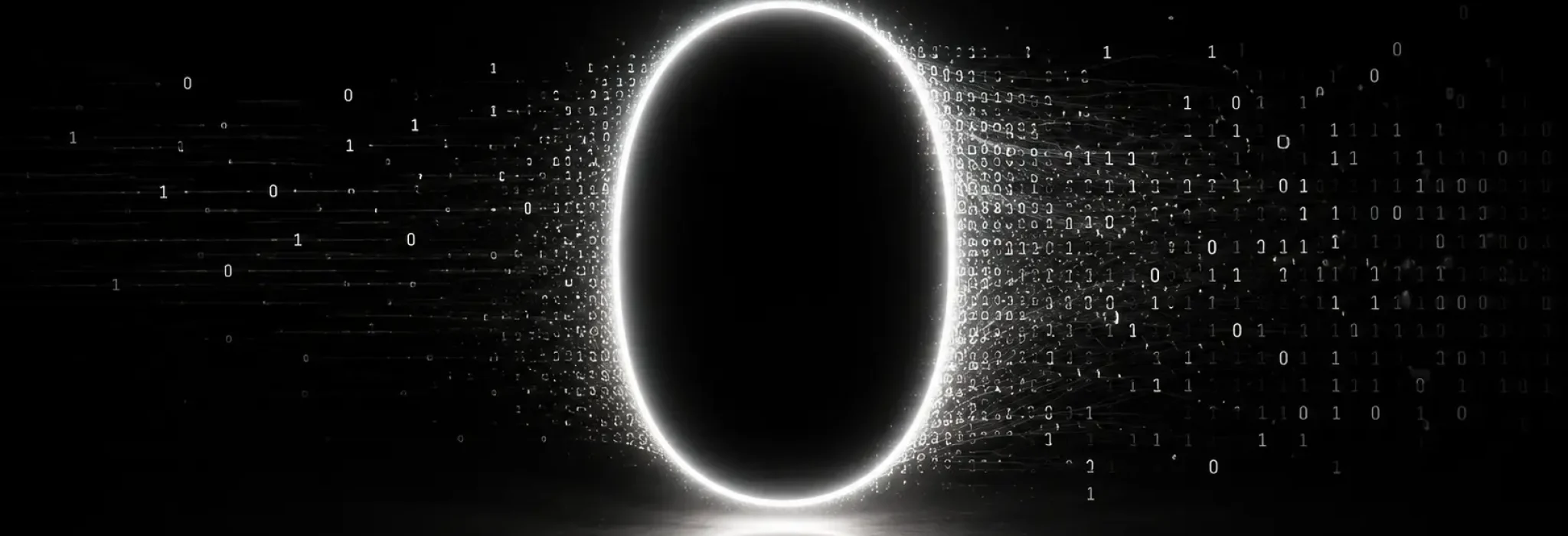
Some symbols derive their power not from what they immediately represent, but from the layers of meaning they have accumulated throughout history. The number 0 is one of them.
At first glance, it appears to represent nothing more than the absence of quantity. Yet few ideas have had such a profound influence on mathematics, philosophy, culture, and the ways civilizations have come to understand the world.
Far beyond its numerical function, zero has become a symbol associated with emptiness, potential, cycles, and new beginnings. These interpretations do not belong to a single tradition, nor do they constitute a universal meaning. Rather, they illustrate how a simple written sign has inspired reflections that span cultures, historical periods, and systems of thought.
The Invention of Absence
Today it seems natural to write numbers such as 101 or 2,005, but for much of history this was far from straightforward.
Civilizations such as the Egyptians, Greeks, and Romans developed sophisticated numerical systems, yet none employed zero as we know it today. The idea of representing the absence of quantity with a symbol of its own took centuries to emerge.
It was in India, during the first centuries of the Common Era, that zero began to take the form we use today. Scholars of the Islamic world later refined and transmitted this numerical system, which eventually reached medieval Europe and transformed mathematics.
The emergence of zero changed not only mathematics but also the way the symbol itself came to be understood. What began as a practical solution for representing absence gradually acquired philosophical, cultural, and symbolic meanings far beyond anything its creators likely imagined.
The Number That Represents Nothing—and Therefore Means So Much
Few ideas seem as simple—and yet as difficult to grasp—as emptiness.
An empty glass still exists.
An empty room remains a room.
Silence is not the complete absence of sound, but a space in which other sounds may emerge.
In much the same way, zero does not simply represent “nothing.” It represents a place reserved for what is not present at a given moment.
This seemingly subtle distinction transformed the way numbers are written.
Without zero, distinguishing between 15, 105, and 1,005 would be far more difficult. Its role as a placeholder made the decimal system that we rely on every day possible.
When Emptiness Becomes Possibility
Across many philosophical traditions, emptiness has never been understood merely as absence.
Certain schools of Eastern philosophy describe emptiness as a state of potential from which new forms can emerge. Other philosophical traditions view it as openness, receptivity, or the space that has yet to be filled.
These interpretations belong to specific cultural contexts and should not be mistaken for a universal meaning of the number zero. Nevertheless, they reveal how different societies found value precisely in what appeared to contain nothing at all.
Perhaps because every beginning first requires space in which to unfold.
Zero in Numerology
Not every school of numerology treats the number zero in the same way.
In many traditional systems, zero does not play a central interpretive role, since calculations typically result in the numbers 1 through 9, along with the so-called Master Numbers in certain traditions.
More recent approaches sometimes assign zero a symbolic role associated with potential, completeness, or the amplification of the number with which it appears.
As with numerology as a whole, these interpretations belong to symbolic traditions. There is no consensus among different schools, nor is there scientific evidence supporting these symbolic meanings.
The Perfect Circle
There is a reason why zero came to be represented as a circle. Although this shape emerged through the historical evolution of numerical writing, its geometry naturally encouraged symbolic interpretation.
Without a visible beginning or end, the circle has long been associated in many cultures with continuity, wholeness, cycles, and unity. As zero adopted this form, many traditions came to see it as a symbol capable of expressing ideas that extended far beyond mathematics.
Its presence is not difficult to recognize in the world around us.
Planets follow orbital paths.
The seasons return.
A clock completes its revolutions.
The rising and setting of the sun repeat a rhythm that has accompanied humanity for millennia.
These associations do not arise from any universal meaning of the number itself, but from the ways symbols evolve through history. The same circle may represent perfection, eternity, renewal, or potential depending on the cultural tradition interpreting it. In the case of zero, such readings helped transform it from a mathematical symbol into one of the richest and most open-ended symbols of human experience.
The Invisible Number Behind Technology
It is striking to realize that the digital world depends upon the very number that represents absence.
Every piece of information stored on computers, smartphones, or satellites is built from the combination of just two symbols: 0 and 1.
Together, these numbers form the binary system—the fundamental language of computing.
Every photograph, song, video, website, and message exists because countless sequences of zeros and ones are processed at extraordinary speeds.
It is remarkable that a symbol originally created to represent absence has become indispensable for storing and transmitting nearly all of humanity’s digital information. This transformation demonstrates that symbols do not remain static: while their form may endure, their meanings and functions continue to evolve alongside culture, science, and technology.
What Can Zero Symbolize?
The symbolism of zero lies not in claiming that it possesses a single meaning, but in recognizing the diversity of interpretations developed across cultures and traditions.
Some associate it with emptiness, while others connect it with potential, origins, wholeness, or the recurring cycles of existence. These interpretations are neither universal nor objective. Instead, they reflect humanity’s enduring tendency to attribute symbolic meaning to forms and ideas that extend beyond their practical function.
From this perspective, zero may serve as a metaphor for moments of pause, preparation, and transformation. Just as an empty space makes room for something new, periods of silence, endings, or transition may create the conditions necessary for new beginnings.
The symbolism of zero invites precisely this reflection: not every absence represents loss. In many contexts, absence becomes the very condition from which something new can emerge.
A Reflection
For centuries, zero was regarded as unnecessary—or even meaningless. Today we know that without it, much of modern mathematics, science, and technology would simply not exist.
Its history demonstrates how an apparently simple symbol can profoundly reshape the way civilizations understand the world. Over time, zero ceased to represent only the absence of quantity and became a starting point for philosophical, cultural, and symbolic reflection.
Perhaps that is the source of its enduring fascination.
Within a single form, zero brings together ideas that appear contradictory: absence and possibility, silence and creation, endings and new beginnings. None of these meanings belongs inherently to the number itself. Rather, they emerged from the ways different cultures have interpreted its presence throughout history.
It is this extraordinary ability to unite such diverse perspectives that makes zero one of the most compelling symbols ever created by humanity.