
Reading time: 5 minutes
We are surrounded by symbols. They appear in our dreams, in stories passed down through generations, in religious traditions, in works of art, and even in everyday choices we make without realizing it. Long before the invention of writing, people relied on images, patterns, and recurring motifs to make sense of the world, preserve knowledge, and express the human experience.
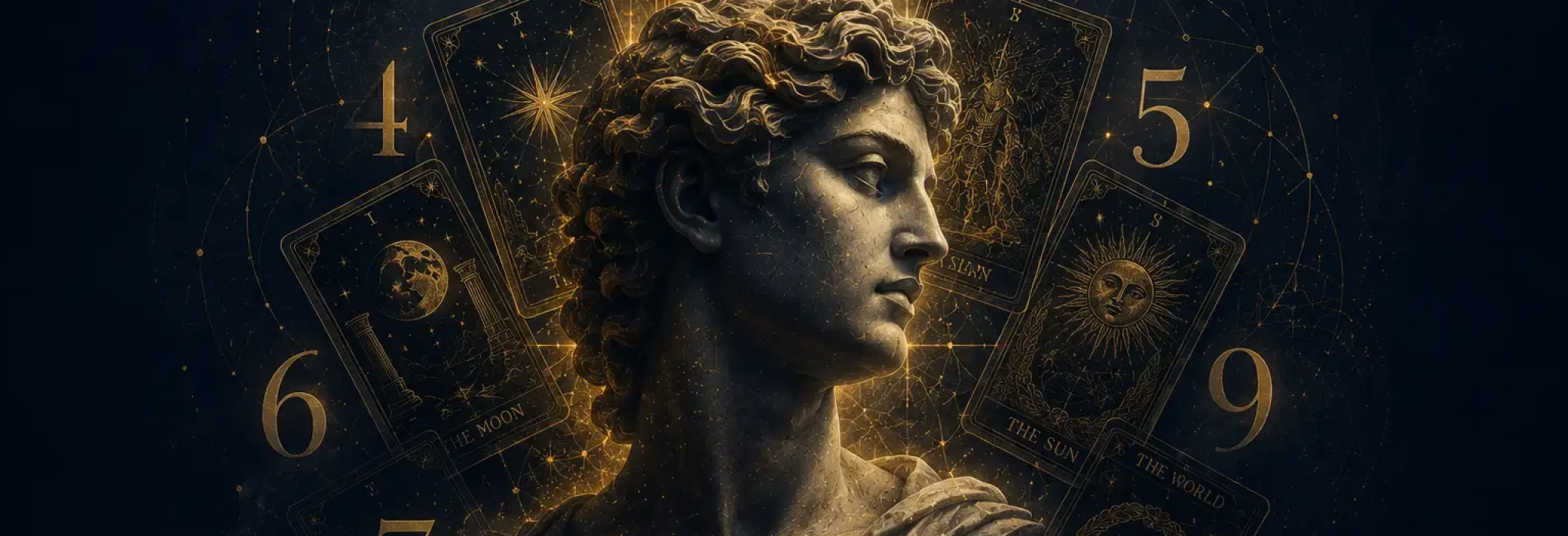
Among the many symbolic traditions that have endured throughout history, three stand out for their lasting influence: Numerology, Tarot, and Archetypes. Although they emerged in different historical and cultural contexts, they share a common purpose: providing a symbolic language for exploring the deeper dimensions of human life.
Rather than viewing them simply as methods of prediction or esoteric systems, they can be understood as tools for reflection, self-discovery, and recognizing the patterns that shape how we think, feel, and relate to the world around us.
Symbolism as a Universal Language
A symbol is far more than an image or an object. It represents an idea, an experience, or a concept that cannot always be fully expressed through words alone.
Across many cultures, the circle symbolizes wholeness, continuity, and unity. The tree often represents growth, renewal, and the connection between different realms of existence. Water is widely associated with transformation, emotion, and the unconscious.
The fact that these meanings appear repeatedly across civilizations separated by time and geography suggests that certain symbols resonate with universal aspects of the human experience.
This is precisely where Numerology, Tarot, and Archetypes intersect: each uses symbols as a way of organizing, interpreting, and giving meaning to reality.
Numerology: When Numbers Become Symbols
In Numerology, numbers are understood as more than mathematical values. They represent symbolic qualities, recurring cycles, and underlying principles that offer a different way of understanding human experience.
As early as ancient Greece, philosophers such as Pythagoras viewed numbers as expressions of the order and harmony of the universe. Over time, different traditions developed symbolic systems that associate numbers with personality traits, life themes, and developmental cycles.
Within this symbolic framework, each number carries its own central meaning.
1 is commonly associated with initiative, independence, and new beginnings.
2 represents balance, cooperation, and relationships.
3 is linked to creativity, communication, and self-expression.
4 symbolizes stability, structure, and building strong foundations.
These meanings should not be understood as absolute truths, but as symbolic references that encourage reflection on different dimensions of life.
Tarot: A Symbolic Map of the Human Journey
Tarot is made up of a deck of richly symbolic cards. Historically, it originated as a card game in Europe during the fifteenth and sixteenth centuries, while its use as a symbolic and reflective tool developed much later.
The 22 Major Arcana include figures such as The Fool, The Empress, The Hermit, and The World. Each represents challenges, transformations, and stages that are part of the human journey.
Rather than pointing to a fixed destiny, Tarot can be understood as a visual language that encourages reflection on choices, change, and personal development.
The Hermit, for example, often symbolizes introspection and the search for wisdom. Wheel of Fortune represents the natural cycles of life. Justice is associated with balance, responsibility, and the consequences of our choices.
Taken together, these images form a symbolic narrative about growth, transformation, and psychological development.
Archetypes: Universal Patterns of the Psyche
The concept of archetypes was developed most extensively by the Swiss psychiatrist Carl Gustav Jung.
According to Analytical Psychology, universal patterns exist within the collective unconscious, influencing how people perceive the world, create stories, and make sense of their experiences.
Jung observed that these patterns appear repeatedly in myths, folklore, religious traditions, literature, and cultural expressions from societies across the world, including those that developed independently of one another.
The Hero represents courage in the face of challenges.
The Wise Old Man symbolizes knowledge, guidance, and insight.
The Shadow embodies the aspects of the personality that we often reject, ignore, or fail to recognize.
The Great Mother represents nurturing, protection, and fertility.
These archetypes do not describe specific individuals. Instead, they represent symbolic patterns that may emerge in different ways throughout life and across cultures.
How These Three Pillars Connect
Although they use different symbolic languages, Numerology, Tarot, and Archetypes share the same underlying logic.
- All seek to understand processes of transformation.
- All rely on symbols rather than literal explanations.
- All offer ways of reflecting on identity, choices, life cycles, and human development.
The same idea may appear through different symbolic systems.
For example, the number 9 is commonly associated with completion and the end of a cycle.
In Tarot, The World also symbolizes completion, fulfillment, and integration.
In Analytical Psychology, the process of individuation represents the integration of the different aspects of the personality into a more complete and authentic whole.
These are different symbolic languages that ultimately point toward the same human experience: recognizing that every ending also creates the possibility for a new beginning.
More Than Answers: Tools for Reflection
A thoughtful understanding of these traditions avoids deterministic interpretations.
- Numbers do not determine the future.
- Cards do not control destiny.
- Archetypes do not define who someone must become.
Their greatest value lies in their ability to broaden perspective, encourage meaningful questions, and support self-understanding.
Symbols function like mirrors. They do not provide ready-made answers but offer images that help us view reality from new perspectives and develop more conscious interpretations of our own experiences.
An Invitation to Understand the Language of Symbols
Numerology, Tarot, and Archetypes remain relevant because they explore questions that have accompanied humanity throughout history: identity, choice, transformation, challenge, and growth.
Each tradition offers its own way of approaching these themes, yet all converge on the same fundamental idea: understanding symbols is also a way of understanding ourselves.
By recognizing the meanings embedded in numbers, images, and narratives that have crossed cultures and generations, we begin to see that symbolism is not merely a relic of the past. It remains a living language that continues to shape how we think, feel, and interpret the world.